
SMT Red Glue PCB Assembly Process: Complete Industrial Manufacturing and DFM Guide
Introduction: A Manufacturing Engineer’s Perspective on PCB Stability
As a PCB manufacturing engineer working in SMT production lines for industrial electronics, I often get asked one key question:
“Why do we still use the SMT red glue PCB assembly process when solder paste already exists?”
From a high-volume production perspective, SMT red glue is not just a material—it is a mechanical stability strategy. It is used in complex PCBA scenarios where solder paste alone cannot guarantee structural integrity. At Wells, we specialize in high-reliability industrial PCB assembly, where SMT epoxy adhesive (also known as PCB red adhesive) is the unsung hero that prevents component displacement during the turbulent reflow and wave soldering stages.
What is SMT Red Glue PCB Assembly Process?
The SMT Red Glue PCB Assembly Process refers to a surface mount technology method where a single-component epoxy resin is applied to the PCB to temporarily or permanently fix components before they undergo soldering.
Unlike solder paste, which is designed for electrical conductivity, SMT red glue is:
- A Thermosetting Polymer: A single-component epoxy that hardens permanently upon heating.
- Fast-Curing: Engineered to cure within minutes in a reflow oven.
- Non-Conductive: Acts purely as a mechanical “bridge” or anchor.
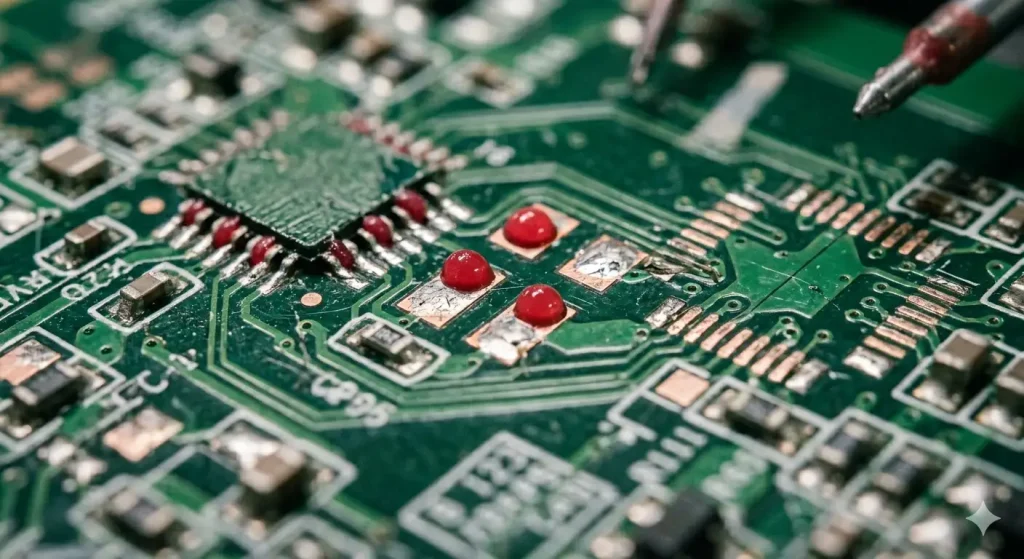
SMT Red Adhesive vs. Solder Paste: Key Differences
| Feature | SMT Red Glue (Adhesive) | Solder Paste |
| Primary Function | Mechanical fixation | Electrical & Thermal connection |
| Conductivity | Dielectric (Non-conductive) | Highly conductive (Tin/Lead/Silver) |
| Color | Red or Dark Orange | Metallic Gray |
| Reflow Behavior | Irreversible curing (Hardens) | Reversible melting (Liquid to Solid) |
| Application Method | Dispensing or Stencil Printing | Stencil Printing |
Engineering Insight: The “Glue-Bond” Trigger
On our SMT assembly lines, we typically trigger the use of SMT epoxy glue when:
- Components exceed a specific weight-to-pad-area ratio.
- The PCB must undergo Wave Soldering after SMT placement.
- Components are mounted on the bottom side of a double-sided board.
Why Use SMT Red Glue in PCB Assembly?
1. Preventing Component Shifting
During high-speed SMT pick and place and subsequent conveyor movement, lightweight components (like 0201 or 0402 resistors) can shift due to inertia or airflow inside the reflow oven. Red glue locks them in place.
2. Enabling Double-Sided PCB Assembly
In a standard double-sided SMT process, the board is flipped. Without the red glue SMT manufacturing technique, heavy components on the “bottom” side might fall off. This is a critical step in advanced multilayer PCB assembly projects where density is high on both layers.
3. Mixed Technology (SMT + Wave Soldering)
When SMT components are placed on the solder side of a through-hole board, they must pass through a molten wave of solder. Wells’ professional PCBA manufacturing services ensure these components are locked in place to survive the thermal shock of the wave.
Learn more aboutIPC-7351B standardsfor surface mount design and land patterns.
SMT Red Glue PCB Assembly Process: Factory Workflow
Step 1: DFM Preparation (Design for Manufacturing)
We analyze the Gerber files to determine “Glue Points.” Our team provides a comprehensive PCB DFM check to ensure that the glue dot won’t contaminate the copper pads.
Step 2: Red Glue Application
There are two primary industrial methods used at Wells:
- Dispensing: A needle applies a precise SMT adhesive dot between the pads. Best for high-mix, low-volume production.
- Stencil Printing: Similar to solder paste printing, using a specialized stencil. This is the gold standard for high-speed mass production.
Step 3: SMT Pick and Place
The placement machine high-speed heads “embed” the component body into the glue dot. This is part of our integrated turnkey PCB assembly workflow, ensuring seamless transition from adhesive application to component mounting.
Step 4: Curing Process
The board passes through a curing oven (or a standard reflow oven with a specific profile).
- Standard Curing: 120°C for 60–120 seconds.
- High-Speed Curing: 150°C for 60–90 seconds.
Step 5: Wave Soldering or Reflow
Once cured, the PCB red adhesive is irreversible. The board can now be flipped or submerged in a solder wave without component loss.
Material Handling & Storage (The “Gold” Rules)
As a manufacturing engineer, I’ve seen more defects from poor storage than from machine errors.
- Temperature: Must be stored at 2°C–8°C.
- Acclimatization: Red glue must “warm up” to room temperature for 2–4 hours before use to prevent moisture condensation.
- De-bubbling: Syringes should be centrifuged to remove air bubbles, which cause “skipping” during dispensing.
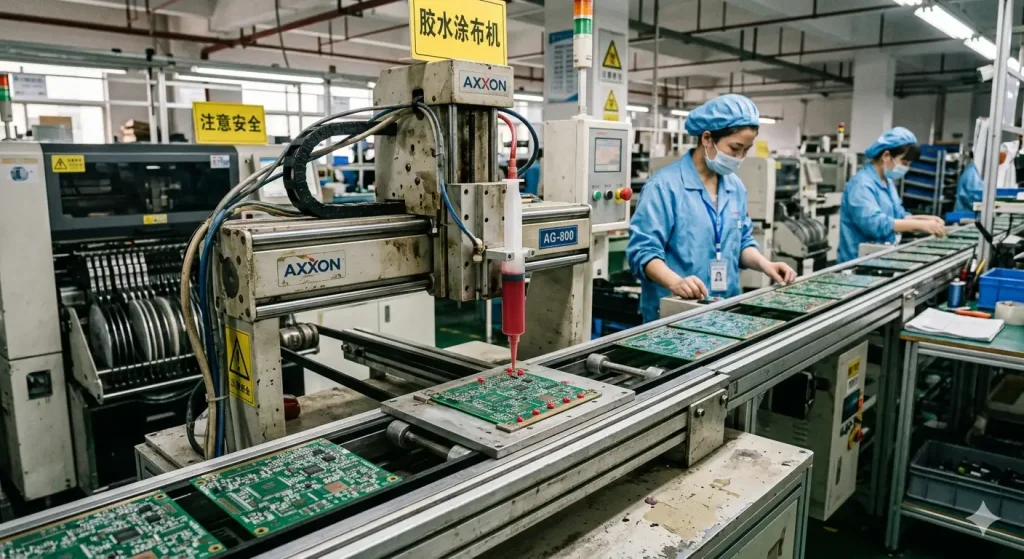
DFM Design Rules for SMT Red Glue Optimization
To reduce SMT assembly process costs, Wells engineers recommend following these rules during the PCB design phase:
-
Rule 1: Minimize Bottom-Side Weight. If possible, keep all heavy components (inductors, large electrolytic capacitors) on the top side.
-
Rule 2: Pad Clearance. Ensure a minimum clearance of 0.15mm to 0.2mm between the glue dot and the solder pad to avoid contamination.
-
Rule 3: Dot Sizing. The glue dot height should be slightly higher than the gap between the component body and the PCB (usually 0.1mm to 0.2mm).
-
Rule 4:Avoid Through-Vias under Glue.This prevents “popcorning” during the heating of your custom PCB prototype.
Common Defects & Troubleshooting
Glue Overflow: Glue on pads leads to poor wetting. Solution: Reduce dispensing volume.
Component “Floating”: Too much glue lifts the component off the pads. Solution: Adjust Z-axis placement pressure.
Brittle Failure: If curing temperature is too low, the bond will snap during wave soldering.
Stringing (Tailing): When the dispensing needle pulls a “tail” of glue across the board. Solution: Adjust glue viscosity or needle temperature.
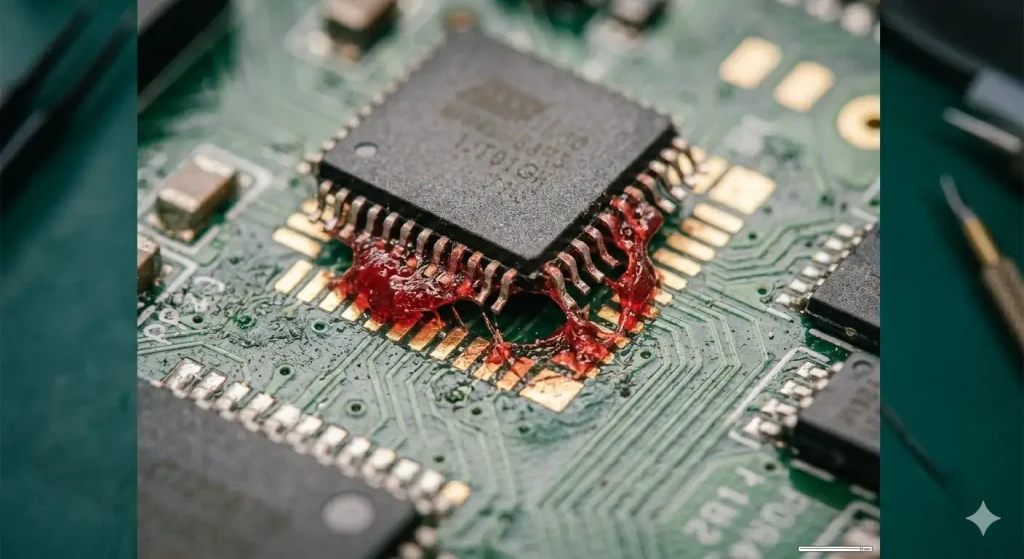
Advantages and Disadvantages
| Advantages | Disadvantages |
| Extreme mechanical vibration resistance | Increases production cycle time |
| Essential for mixed SMT/PTH boards | Rework is extremely difficult (requires heat) |
| Prevents “Tombstoning” of small parts | Higher material and equipment maintenance costs |
| Increases yield for heavy components | Risk of pad contamination |
Engineer’s Conclusion
The SMT red glue PCB assembly process remains a cornerstone of industrial electronics manufacturing. While we always aim to simplify designs to use only solder paste, the reliability requirements of automotive, aerospace, and industrial control systems often make SMT epoxy adhesive a necessity.
At Wells, we combine decades of manufacturing expertise with rigorous quality control to ensure your complex assemblies are built to last. If you are unsure whether your project requires red glue, contact our engineering team for a free consultation.
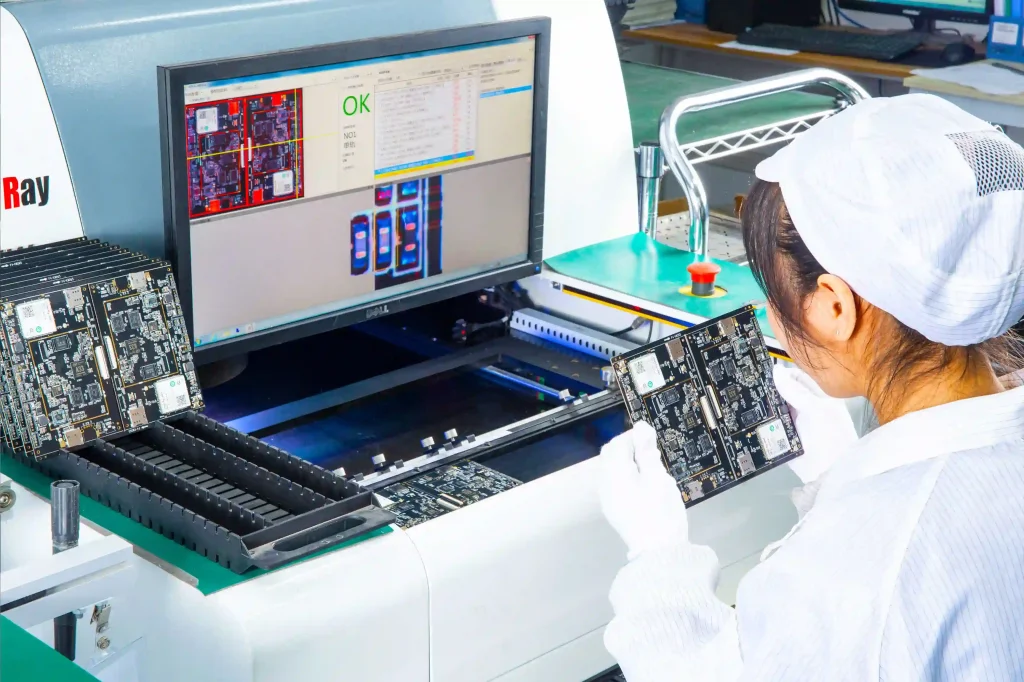
Pro-Tip: Always prioritize a DFM-first approach. If you can design your board to avoid red glue, you save money; if you can’t, ensure your glue points are precisely defined to maintain high yields.
FAQ
❓ Is SMT red glue conductive?
No, it is a dielectric insulator. If it gets on the pads, it will block the electrical connection, causing an open circuit.
❓ Can I reuse red glue after it has been at room temperature?
Most manufacturers recommend a 24-hour limit for room-temperature exposure. After that, the chemical properties begin to degrade.
❓ How do you remove a component fixed with red glue?
You must use a localized heat gun (approx. 250°C–300°C) to soften the epoxy, then use tweezers to twist and remove the component. For more on rework, see the SMTA (Surface Mount Technology Association) resources.
❓ Does red glue replace solder?
Never. Red glue provides the “handshake” (mechanical), but solder provides the “conversation” (electrical).




 Spanish
  English
  French
  Portuguese
  German
  Italian