
Contract PCB Assembly vs. Full Contract Manufacturing: How to Choose the Best PCBA Partner for Your Project?
In the fast-paced electronics industry, the gap between a successful product launch and a costly delay often lies in a single strategic decision: how you manage your production. As global supply chains become increasingly complex in 2026, many OEMs (Original Equipment Manufacturers) find themselves at a crossroads, weighing the merits of Contract PCB Assembly vs. Full Contract Manufacturing.
While the choice might seem like a simple matter of “partial” versus “total” outsourcing, the reality involves a deep dive into risk management, component traceability, and total cost of ownership (TCO). Should your internal team maintain granular control over every capacitor and resistor, or is it more efficient to leverage the end-to-end expertise of a dedicated manufacturing partner?
At Poços, we’ve overseen thousands of projects—from high-mix, low-volume prototypes to large-scale industrial hardware deployments. We’ve seen firsthand how the wrong model can lead to hidden logistics costs, production delays, or even “dead stock” issues that tie up critical capital.
In this guide, we will break down the fundamental differences between these two models and provide a professional decision-making framework to help you determine which approach best aligns with your technical requirements, production scale, and long-term business goals.
1. Strategic Decision Beyond Price
In today’s volatile global supply chain environment, choosing between Contract PCB Assembly (PCBA) and Full Contract Manufacturing (CM) is no longer just about cost.
It is a strategic decision impacting:
- Time-to-Market
- Supply chain resilience
- Product quality and reliability
- Internal engineering workload
Based on Wells PCBA’s experience across thousands of OEM/ODM projects, many companies don’t fail due to pricing—they fail due to hidden costs, poor coordination, and supply chain risks.
👉 If you’re new to outsourcing, start with our PCBA Manufacturing Services Guide
2. Understanding the Scope of Contract PCB Assembly vs. Full Contract Manufacturing
What is Contract PCB Assembly?
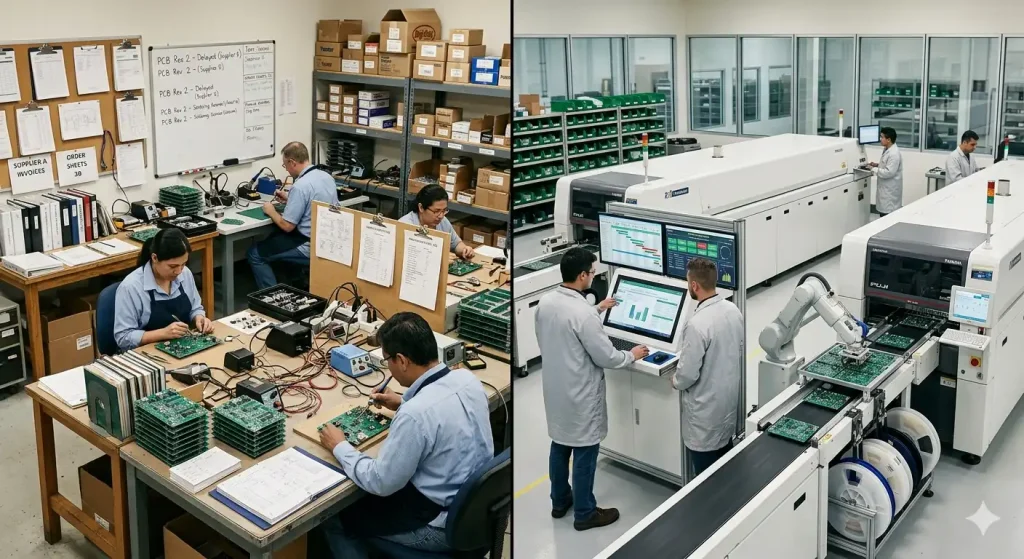
Contract PCB Assembly focuses on board-level assembly only, including:
SMT (Surface Mount Technology)
THT (Through-Hole Assembly)
Reflow soldering
AOI/X-ray inspection
👉 In this model, the OEM typically provides:
PCB files (Gerber)
BOM (Bill of Materials)
Some or all components
📌 Best for:
Prototyping
Engineering validation
Teams with strong supply chain control
What is Full Contract Manufacturing?
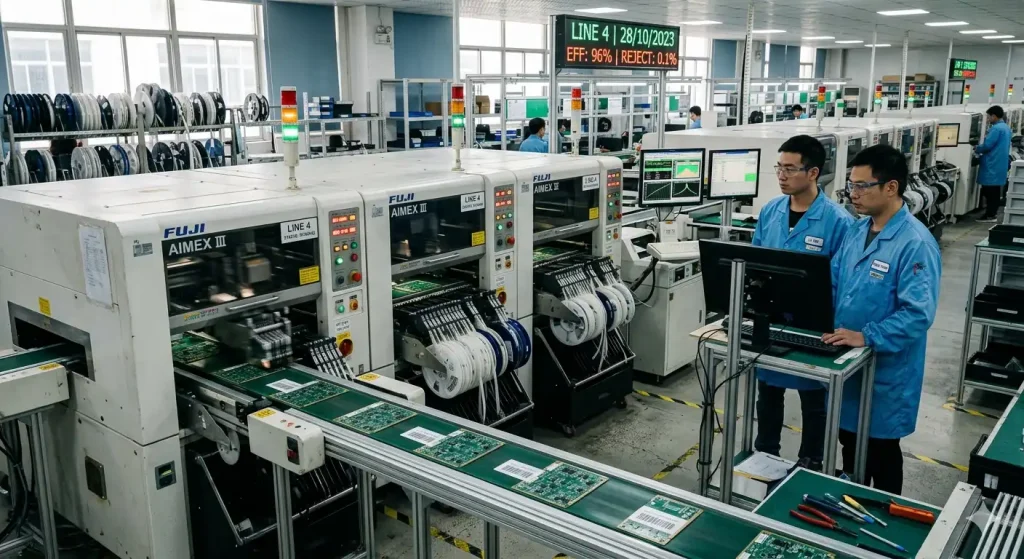
Full Contract Manufacturing (Turnkey EMS) is an end-to-end solution, covering:
- DFM (Design for Manufacturability)
- Component sourcing
- Fabrico de placas de circuito impresso
- Assembly + testing
- Final product assembly
- Logistics & global delivery
👉 Learn more about turnkey solutions:
➡️ [Turnkey PCB Assembly Services]
📌 Best for:
- Mass production
- Scaling startups
- Companies lacking supply chain infrastructure
3. Evaluating Total Cost of Ownership (TCO)
Many buyers compare unit price only—this is a mistake.
A smarter approach is TCO (Total Cost of Ownership):
| Cost Factor | Contract PCB Assembly | Full Contract Manufacturing |
|---|---|---|
| Unit Price | Lower | Slightly higher |
| Internal Management Cost | High | Low |
| Procurement Risk | High | Low |
| Communication Overhead | High | Minimal |
| Time-to-Market | Slower | Faster |
| Yield Stability | Variable | Consistent |
Hidden Costs in Partial Outsourcing
When choosing PCB Assembly only, OEMs must manage:
- Multiple suppliers (PCB + components + logistics)
- Inventory risks (shortages, excess stock)
- Engineering miscommunication
- Delays due to missing parts
📉 These costs are often invisible but critical
Efficiency Dividend of Full Turnkey Solutions
Full CM providers like Wells PCBA offer:
- Centralized sourcing
- BOM optimization
- Real-time production tracking
- Reduced coordination effort
👉 According to IPC industry practices, integrated manufacturing significantly improves yield and traceability.
4. Why DFM is Crucial in Contract PCB Assembly vs. Full Contract Manufacturing
Design for Manufacturability (DFM) is where top-tier manufacturers stand out.
At Wells, engineers typically identify:
- Pad design issues
- Component spacing risks
- Thermal imbalance problems
- Soldering defects before production
In Full Contract Manufacturing
DFM enables:
- Fewer prototype iterations
- Better component lifecycle planning
- Reduced risk of component obsolescence
👉 Refer to IEEE guidelines for design optimization principles.
In Contract PCB Assembly
OEMs must:
- Validate designs independently
- Bear risks of design flaws
- Handle re-spins and delays
📌 This often leads to longer development cycles

5. Ensuring Quality and Transparency in Full Contract Manufacturing
Component Traceability & Anti-Counterfeit Measures
A reliable CM partner should provide:
- Approved vendor sourcing
- Lot traceability
- Anti-counterfeit inspection
👉 Standards such as
ISO 9001 and IPC-A-610 are critical benchmarks.
Quality Control Systems
Wells PCBA integrates:
- AOI (Automated Optical Inspection)
- X-ray inspection
- Functional testing
- MES tracking systems
📌 This ensures full visibility from component to final product
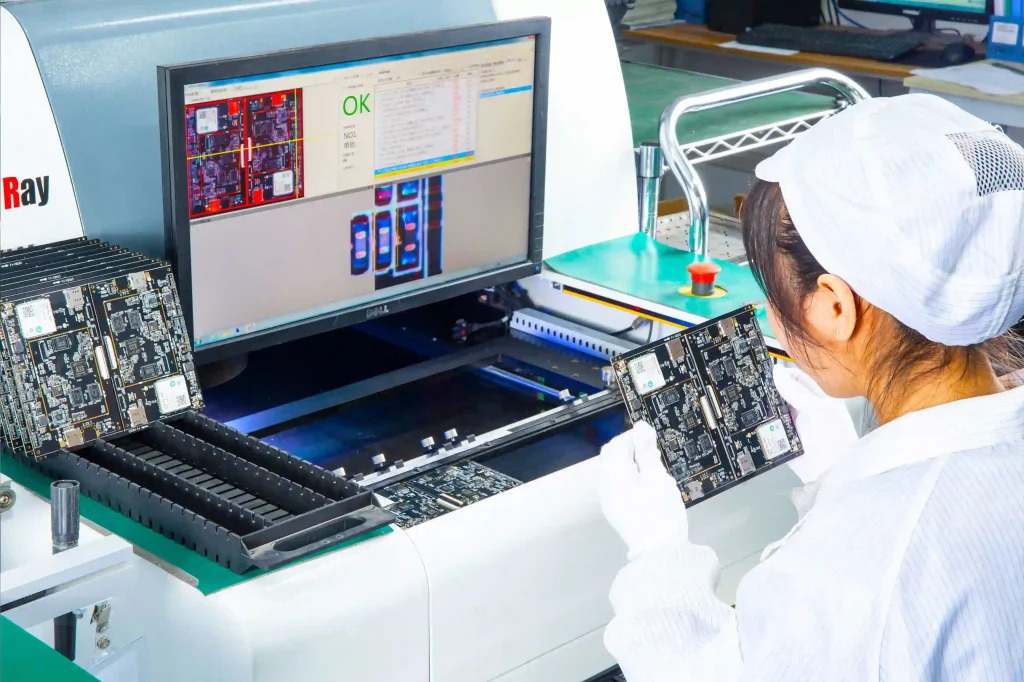
6. Visual Comparison: OEM Workload Difference
📊 Responsibility Breakdown
| Task | Contract PCB Assembly | Full Contract Manufacturing |
|---|---|---|
| PCB Fabrication | OEM | CM Provider |
| Component Sourcing | OEM | CM Provider |
| Supplier Management | OEM | CM Provider |
| Assembly | CM Provider | CM Provider |
| Testing | Shared | CM Provider |
| Logistics | OEM | CM Provider |
📈 Workload Visualization
Contract PCB Assembly:
OEM ████████████████████████ 80%
CM ████████ 20%
Full Contract Manufacturing:
OEM ████ 20%
CM ████████████████████████ 80%
👉 This clearly shows how Full CM frees internal resources
7. Strategic Selection by Product Lifecycle
| Stage | Recommended Model | Reason |
|---|---|---|
| Prototype / R&D | Contract PCB Assembly | Flexibility, control |
| NPI (New Product Introduction) | Hybrid | Risk balancing |
| Mass Production | Full Contract Manufacturing | Scale & efficiency |
| Mature Product | Full CM + VAVE | Cost optimization |
What is VAVE?
Value Analysis / Value Engineering (VAVE) helps:
- Reduce material costs
- Improve manufacturability
- Extend product lifecycle
8. FAQ
Not necessarily PCBA. While unit price is lower, total cost (TCO) is often higher due to hidden operational costs.
Yes. It reduces complexity and allows startups to focus on product and market, not supply chain management.
Choose manufacturers with:
- Authorized sourcing channels
- Traceability systems
- Compliance with IPC and ISO standards
When:
- Production volume increases
- Supply chain becomes complex
- Internal resources are limited
9. Final Verdict: Optimize Your Supply Chain with Wells PCBA
There is no one-size-fits-all solution.
The key is alignment between your product stage, internal capabilities, and growth goals.
👉 With deep expertise in:
- High-mix low-volume PCBA
- Turnkey manufacturing
- Industrial & high-reliability electronics
Wells PCBA helps OEMs reduce risk, accelerate time-to-market, and scale efficiently.
🚀 Call to Action
Ready to optimize your manufacturing strategy?
👉 Upload your:
- BOM file
- Gerber files
And get:
✅ Free DFM analysis
✅ Cost breakdown report
✅ Lead time estimation




 Portuguese
  English
  French
  Spanish
  German
  Italian